
Litus and UWin Nanotech sign MOU on battery and lithium recovery
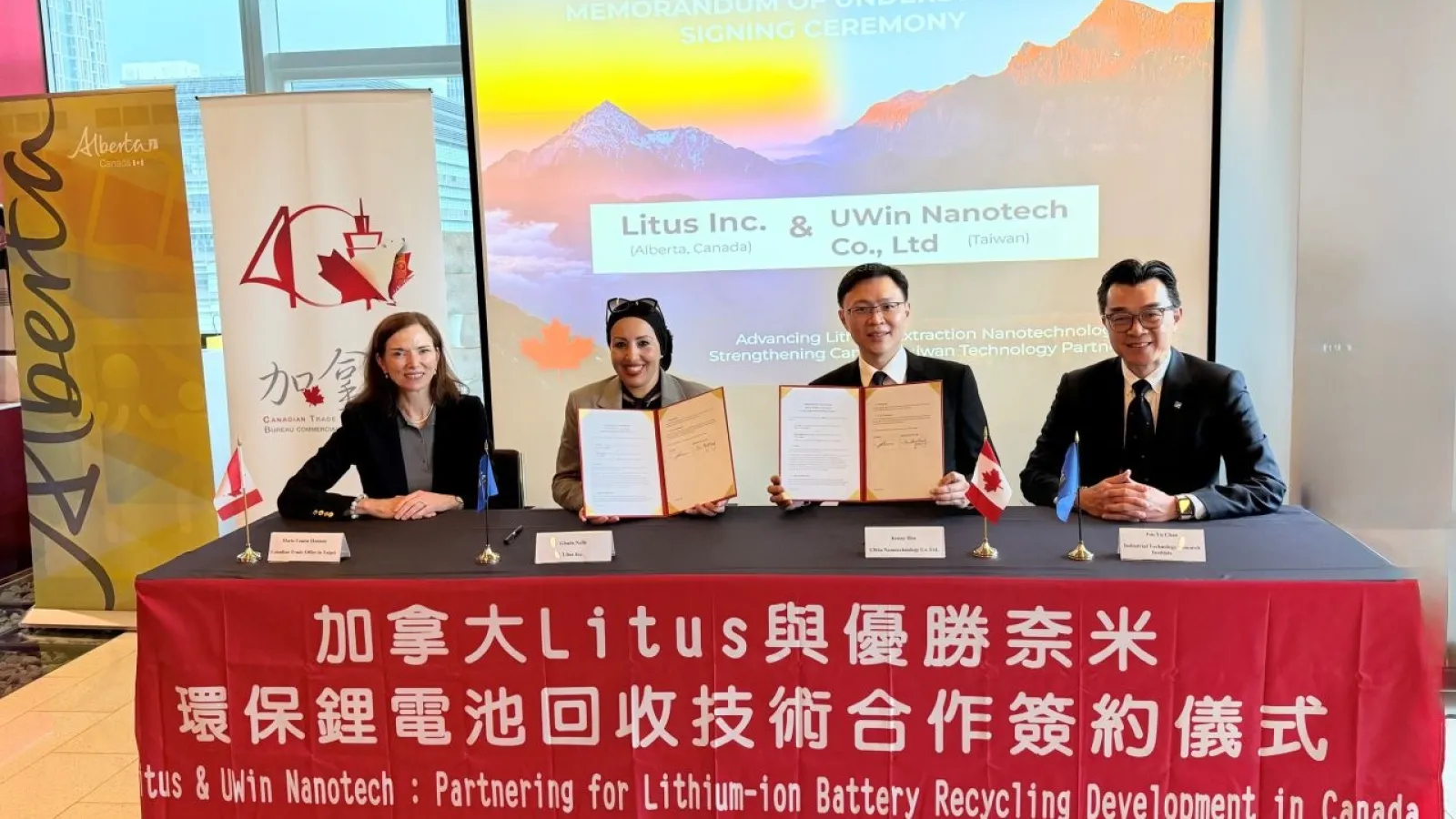
Litus, a Calgary-based critical-minerals company, has signed a memorandum of understanding (MOU) with Taiwan's UWin Nanotech to explore a joint development programme covering lithium extraction and battery recycling. The non-binding agreement — witnessed at a signing ceremony in Taipei attended by a representative from the Canadian Trade Office — sets out intentions to combine Litus's proprietary nanomaterial composites with UWin's hydrometallurgy processing expertise to recover cobalt, nickel, lithium and rare earth elements from recycled streams.
The MOU does not commit either party to a definitive agreement, a capital contribution, or a commercial deployment timeline. No financial terms were disclosed.
The technology
Litus is advancing two technology platforms. Its flagship LiNC™ system is a patented, single-step direct lithium extraction (DLE) process using nanocomposite materials to selectively strip lithium from low-concentration brines — including oilfield produced water and geothermal sources that have historically been considered sub-economic. DLE is an emerging category attracting significant investor attention as an alternative to conventional evaporation-pond processing, which is slow, water-intensive and geographically limited.
The second platform, ReLiGN™, is a battery recycling system the company says uses the same nanocomposite materials to recover battery-grade lithium from end-of-life cells with low energy consumption and minimal hazardous waste. Founder and chief executive Dr Ghada Nafie described end-of-life batteries as "repositories of high-value materials" that ReLiGN™ can process to battery-grade specifications. UWin, which holds more than 20 patents across ten countries and has been a certified Apple supplier for e-waste recycling since 2020, brings hydrometallurgy credentials to the collaboration.
Market context
Critical-mineral supply-chain security has become a policy priority in North America, the EU and across East Asia. Lithium demand — driven by electric-vehicle (EV) battery manufacturing, grid-scale energy storage and consumer electronics — is forecast to grow sharply through the 2030s, while primary supply from brine and hard-rock mining has struggled to keep pace with both volumes and the purity specifications required by battery makers.
Battery recycling sits at the intersection of the circular economy and critical-mineral security: closed-loop lithium recovery reduces dependence on newly mined material and, in jurisdictions with strong recycling mandates, generates compliance value for original equipment manufacturers (OEMs) and cell producers. Several well-capitalised players — including established pyrometallurgy and hydrometallurgy recyclers as well as a new wave of DLE specialists — are competing to prove commercial-scale recovery economics. The nanotechnology-based selectivity that Litus claims for both LiNC™ and ReLiGN™ is its proposed point of differentiation, though neither platform has yet disclosed independently verified throughput or recovery-rate data at commercial scale.
The Canada–Taiwan trade dimension is also notable. The Canadian Trade Office in Taipei's presence at the signing reflects Ottawa's push to diversify critical-mineral processing partnerships beyond Chinese-controlled refining capacity, which currently dominates global lithium carbonate and cobalt sulphate supply chains.
Policy path
In Canada, the Critical Minerals Strategy and the Strategic Innovation Fund provide potential grant and equity support for domestic processing technology. The US Inflation Reduction Act's 45X advanced-manufacturing credit and the sourcing requirements under the EV battery rules create demand-side incentives for North American recycled lithium that could underpin future offtake for a Litus–UWin product. The EU's Battery Regulation, which mandates minimum recycled-content thresholds phased in from 2027, adds a further demand signal for battery-grade recovered lithium.
Litus says it has operations across North America, Europe and the Middle East. Investors will look for the parties to progress from MOU to a definitive technical or commercial agreement, and for either platform to publish verified recovery data from a pilot or commercial deployment, as the milestones that would move this collaboration from strategic intent to market relevance.