
The demand America refused has landed in Riyadh instead

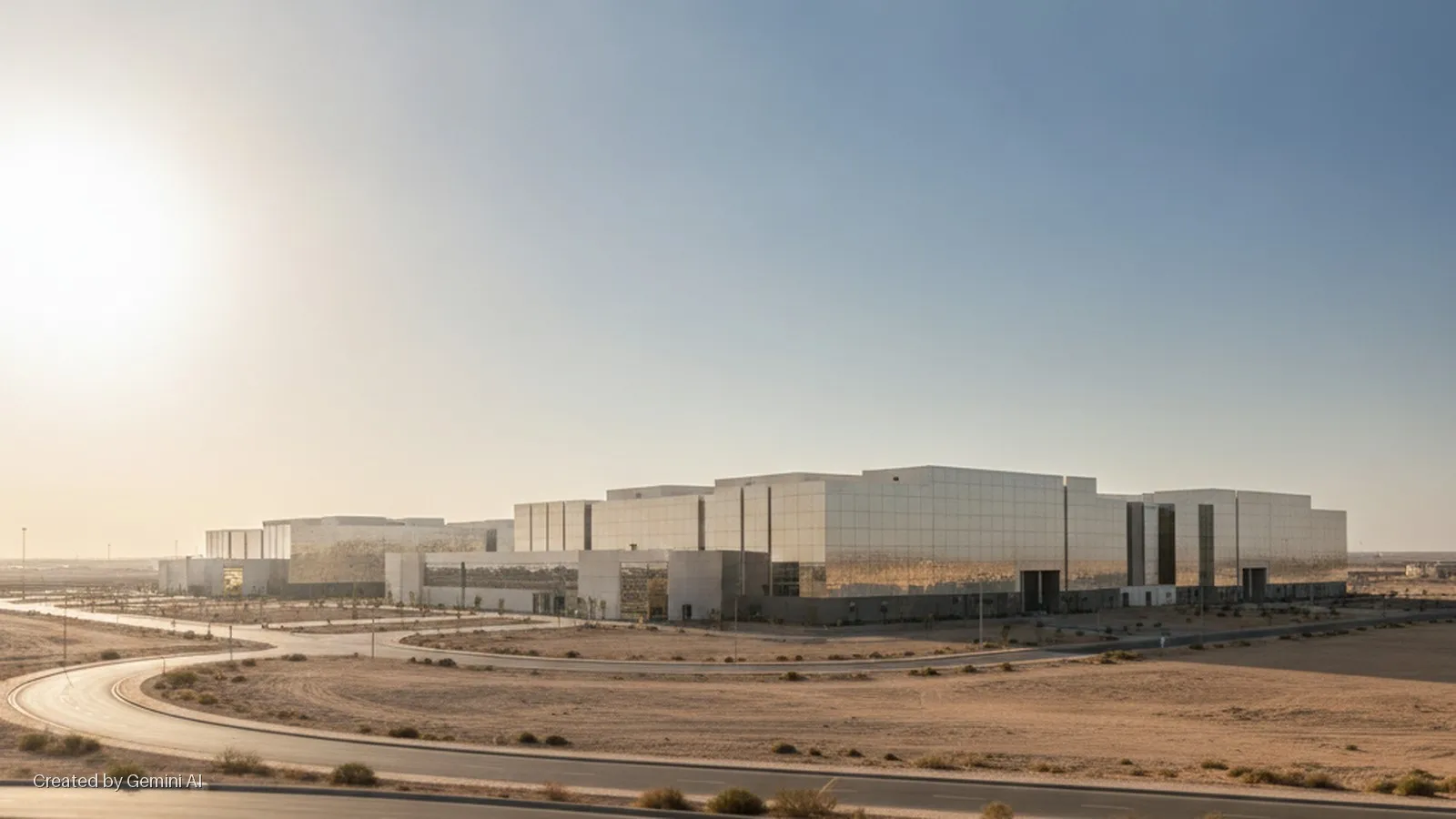
The most revealing sentence to come out of LEAP's opening day was not spoken in Riyadh. It was said by the chief executive of an American company explaining why he had come.
"More and more, local communities don't want data centers in their backyards, and there are a lot of cancellations and moratoriums, so U.S. capacity is becoming even more constrained," Vipul Ved Prakash of Together AI told the New York Times, on the day his company announced a new 250MW data centre in Saudi Arabia with the state artificial intelligence firm HUMAIN. His own company's release is equally direct: access to power is one of the central constraints on AI infrastructure growth, and Saudi power capacity is a key advantage.
That is the clean energy story from day one, and it is a story about where demand goes when a grid and its neighbours stop absorbing it. A Gallup poll in March found 48 per cent of Americans strongly opposed to new data centres in their area, against 7 per cent strongly in favour. The megawatts do not disappear. They relocate.
What Saudi Arabia signed up for
The Kingdom absorbed a great deal on Monday. Together AI's 250MW is the cleanest example because it carries no hedge. Alongside it: up to 250MW of AMD MI400-series infrastructure beginning deployment in 2027, inside a joint venture with Cisco and HUMAIN targeting up to a gigawatt by 2030; a HUMAIN and stc Group data centre programme; 100MW inside DataVolt's 360MW campus at Oxagon in NEOM, with construction begun; up to 50MW in the country's first AI Zone with AWS; and an xAI deployment beginning at 50MW and scaling towards 500MW.
Set that against the installed base. Saudi Arabia operated roughly 467MW of live data centre capacity in the first quarter of 2026, up from 68MW in 2021. The national data centre strategy targets up to 1.5 gigawatts by 2030. HUMAIN has separately tendered infrastructure works for a six-gigawatt campus at Al-Saad in east Riyadh.
Not one megawatt of generation was announced to meet any of it. No power purchase agreement, no build, no grid connection, no storage contract, no hydrogen offtake. Nothing from ACWA Power, whose own newsroom carries no LEAP item at all, nor from Saudi Electricity Company, the National Grid, Badeel or Masdar. The total confirmed by the organiser in its release early on Tuesday morning contains no energy supply item of any kind.
The stage where it could have been said
The topic was not missing from the programme. Climate tech had the Orbital 1 hall for the whole of Monday. Taoufik El Kabir of OmniOps spoke on cutting AI energy consumption without new hardware. Arnaud Castaignet of Skeleton, the supercapacitor storage company, appeared on a panel built around the energy challenge behind the compute build. There was a late session on scaling the energy transition with Strategic Year Holdings, Gobi Partners and Salam. Emad Al Juwaed of Principal Buyer, which is the Saudi Power Procurement Company and the single counterparty to every power purchase agreement in the Kingdom, was on that stage discussing AI in industrial applications rather than procurement.
Aramco is LEAP's energy and innovation partner, and Ahmad Al Khowaiter, its executive vice-president for technology and innovation, had a main stage slot on Monday afternoon titled around powering the world through transition. As of Tuesday morning no account of what he said had been published anywhere, and Aramco's own newsroom carries nothing from the show, its most recent item dating from 24 August. That is a gap worth recording rather than filling. Readers should also be warned that search engines are currently returning a November 2025 Arab News report of Al Khowaiter speaking in Paris against LEAP 2026 queries; the 415 terawatt-hour data centre figure circulating with it belongs to that speech, not this one.
Green hydrogen appeared once all day, on a smart cities panel about renewable hubs and the urban circular economy. It was a discussion, not a deal.
What the minister said, and what it commits to
Alswaha framed the strategy around compute, capital and customers, sitting on top of energy, chips, infrastructure and models, and said the Kingdom aspires to be the most reliable partner supplying the world of intelligence with energy and capability.
That is the right framing and it is probably the Kingdom's genuine comparative advantage. Capital is available in many jurisdictions and Saudi Arabia does not make chips. Cheap, abundant, dispatchable power is the thing it can offer that a constrained American grid and an unwilling American electorate currently cannot.
But an aspiration to supply energy is not a contracted megawatt, and the asymmetry is now stark. Demand arrived on Monday with names, dates and counterparties attached. Supply arrived as a sentence in a keynote. The number to watch this week is not the next capacity announcement. It is the first generation one.