
ProLogium starts mass production of 381 Wh/kg solid-state cell

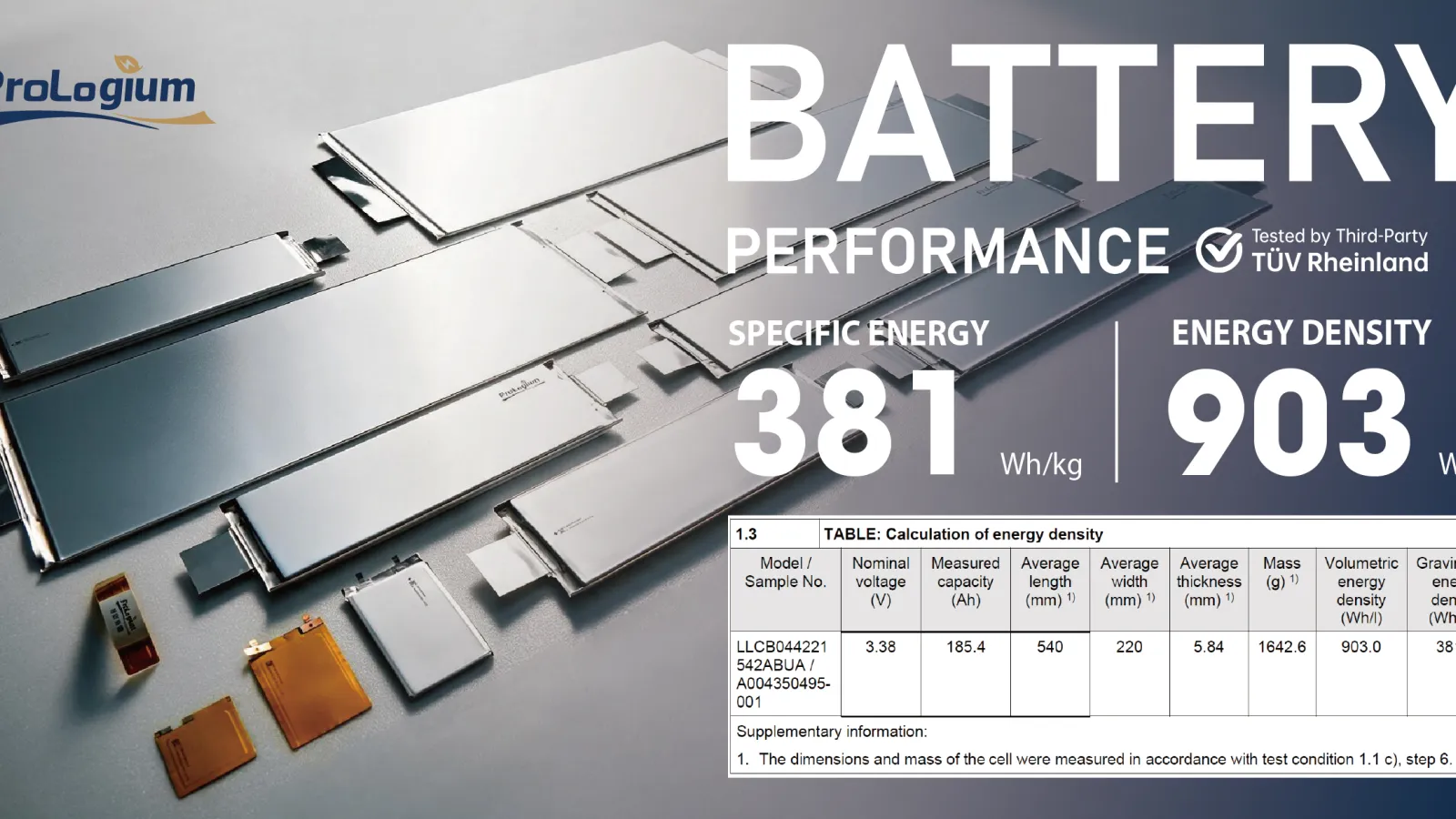
ProLogium Technology has moved its Gen 3.5 Lithium Ceramic Battery (LCB) into mass production at a giga-scale manufacturing facility in Taiwan, marking the first time the company says a high-energy-density all-solid-state battery has progressed beyond laboratory and pilot-scale output to full commercial volumes.
Independent testing underpins the performance claims. A TÜV SÜD report confirmed that ProLogium's 185.4 Ah large-format cell reached 381 Wh/kg gravimetric energy density and 903 Wh/L volumetric energy density, metrics that determine how much stored energy a given weight or volume of cell can deliver. Separately, UL Solutions tested the cell under China's GB/T 43568-2026 methodology, which requires weight loss of less than 0.5% after six hours under vacuum at 120°C to qualify as all-solid-state. The ProLogium cell recorded weight loss of less than 0.05%, well within the threshold. That standard has been submitted to the International Electrotechnical Commission (IEC) as a reference for international classification.
The platform and its customers
ProLogium's manufacturing history stretches back to 2013, when the company began commercial production on a first-generation sheet-by-sheet line targeting consumer electronics and medical devices. A roll-to-roll line followed in 2017, and a third-generation giga-level platform entered operation in 2024. The company reports it has shipped more than 2.4 million cells on the LCB platform across consumer, specialist and automotive applications.
Current automotive customers include an unnamed US audio-systems supplier whose products are installed in vehicles from a Japanese automaker described as ranking among the top three in North American sales. That customer has placed more than 175 repeat orders, with cumulative deliveries exceeding 900,000 cells. ProLogium says it has also secured orders for unmanned systems, where high energy density and fast recharge are critical to payload and endurance. The company obtained IATF 16949 automotive quality-management certification in 2022 and has maintained annual surveillance audits since.
Market context and the road to Gen 4
The all-solid-state battery (ASSB) space has attracted substantial capital from automotive OEMs, governments and specialist investors over the past decade, on the promise of higher energy density, improved safety and reduced fire risk compared with conventional lithium-ion cells. Despite that interest, most programmes from Toyota, QuantumScape, Solid Power and others remain at pilot scale or limited vehicle trials. ProLogium's claim to giga-scale production, if sustained and independently audited at volume, would represent a meaningful step change, though the company has not disclosed total annual capacity in gigawatt-hours or a production cost per kilowatt-hour.
The next technology step is Gen 4 LCB, which uses a fully inorganic superfluidised electrolyte and is designed to add an active safety mechanism (ASM) intended to prevent thermal runaway by stabilising electrode materials at elevated temperatures. ProLogium says roughly 90% of its existing giga-level production equipment can be carried forward to Gen 4, a claim that, if accurate, reduces the capital intensity of the chemistry transition. Targeted applications include electric vehicles, AI data centres, maritime and aerospace.
On manufacturing geography, ProLogium plans a network spanning Taiwan as its technology base, France for scaled production, and a phased North American presence. The North American strategy centres initially on importing core cell layers from France for downstream assembly closer to end customers, with a potential US inlay production facility at a later stage. No site, partner names or capital commitments for the French or North American facilities were disclosed in this announcement.
Investors will focus on disclosed giga-hour capacity figures, named automotive OEM contracts and the timeline for Gen 4 commercial samples as the key near-term milestones.