
HPQ and Novacium deliver 30 silicon-anode drone packs for EU evaluation

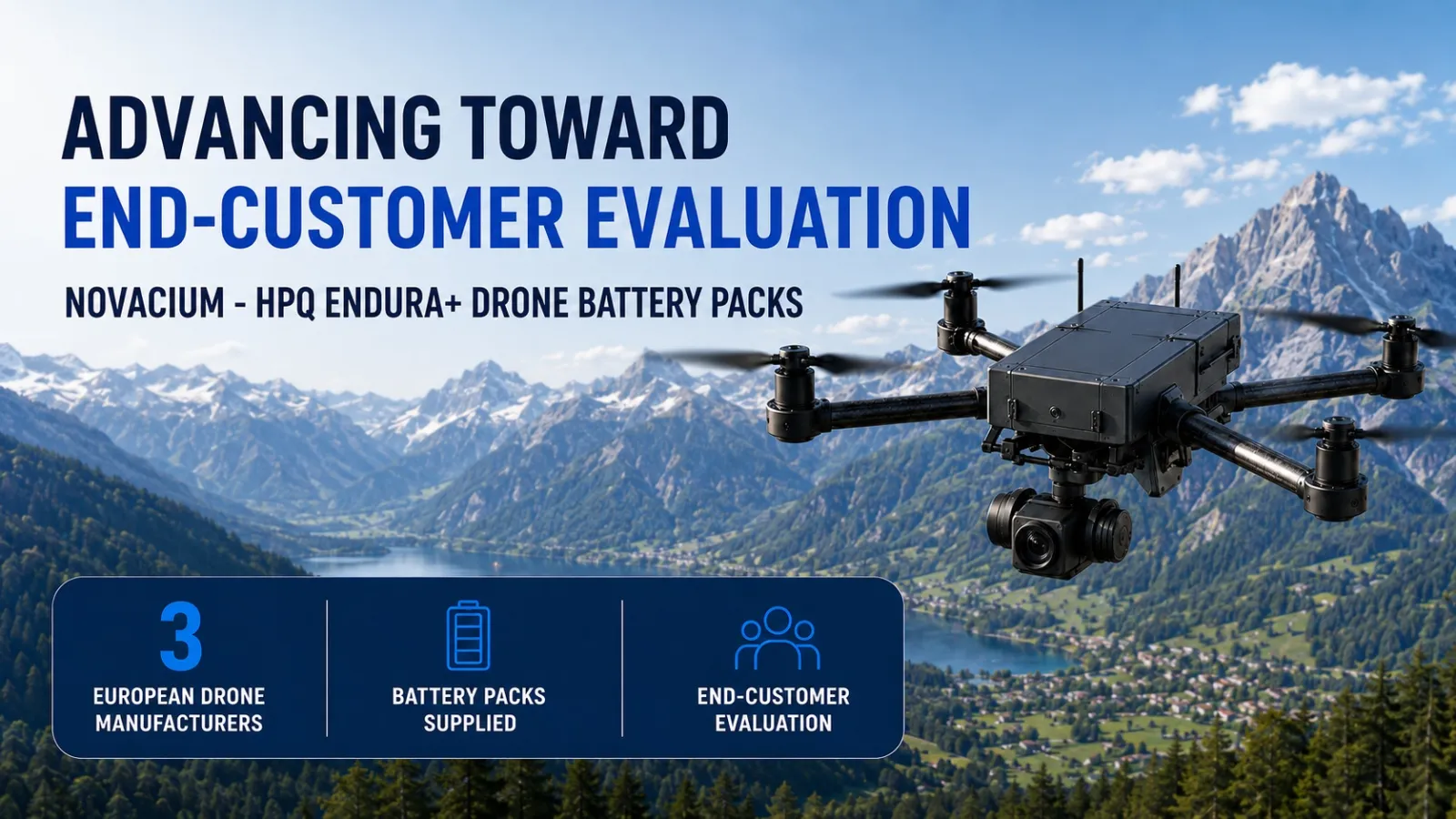
HPQ Silicon and its French partner Novacium SAS have delivered 30 custom-configured battery packs to three unnamed European drone manufacturers for final-stage evaluation, the companies announced on 27 August 2026. Ten packs were supplied to each manufacturer, with each configuration adapted to the specific technical and operational requirements of the recipient's drone platform. The current testing represents what both companies describe as the final planned evaluation stage before any potential product qualification.
The packs incorporate Novacium's proprietary silicon-based anode material, which the company says can achieve higher energy densities than conventional graphite-anode cells. For drone applications, that translates in principle to greater range, higher payload capacity, or an improved balance between the two. Novacium has not disclosed verified energy-density figures or third-party test results; the performance claims in the release are the company's own and have not been independently verified.
HPQ Silicon, listed on the TSX Venture Exchange, holds an equity stake in Novacium and an exclusive North American licence to its battery technologies. The financial terms of that licence and the equity ownership percentage were not disclosed.
Technology context
Silicon-anode lithium-ion batteries are a well-established area of next-generation battery research. Silicon can theoretically store roughly ten times more lithium ions than graphite, but the material expands and contracts significantly during charge-discharge cycles, causing degradation. Novacium's GEN3 and GEN4 anode programmes are aimed at addressing that durability challenge, though the company has not published independent cycle-life data.
Several well-funded materials and cell manufacturers globally, including public companies and venture-backed startups, are pursuing silicon-anode technology for applications ranging from consumer electronics to electric vehicles and aerospace. The drone segment is a relatively small but technically demanding early market, where weight and energy density matter more than in most terrestrial applications, and qualification cycles can be lengthy.
Market and policy backdrop
The European Commission's Drone Strategy 2.0 sets out an ambition to build a large-scale European drone-services market, with the Commission citing an estimate that the sector could reach approximately €14.5 billion by 2030. European industrial policy has increasingly emphasised domestic drone and advanced-battery supply chains, partly in response to concerns over supply-chain dependency on non-European producers. That policy backdrop creates a degree of demand-side pull for European-developed or European-qualified battery technology, though no specific subsidy mechanism tied to drone battery qualification was referenced in the release.
Jed Kraiem, co-founder and chief operating officer of Novacium, said the three evaluation programmes reflect a process that began in the fourth quarter of 2025. "Our present focus is on supporting the manufacturers through this final planned evaluation stage and obtaining further technical feedback on the performance of the packs toward potential product qualification," he said.
Bernard Tourillon, president and chief executive of HPQ Silicon, described the simultaneous progress of all three evaluation programmes as continued validation of the technology across different platforms and operating requirements.
The next material milestone for investors will be whether any of the three manufacturers proceeds to product qualification and a commercial supply agreement. No timeline for qualification decisions, no volumes, and no contracted pricing were disclosed in the announcement. HPQ Silicon carries a cautionary note in its release acknowledging that forward-looking statements on technology performance and market demand are subject to material risks including delays, financing availability, and competition.