
Hyundai and Misk Foundation conclude Seoul leadership programme

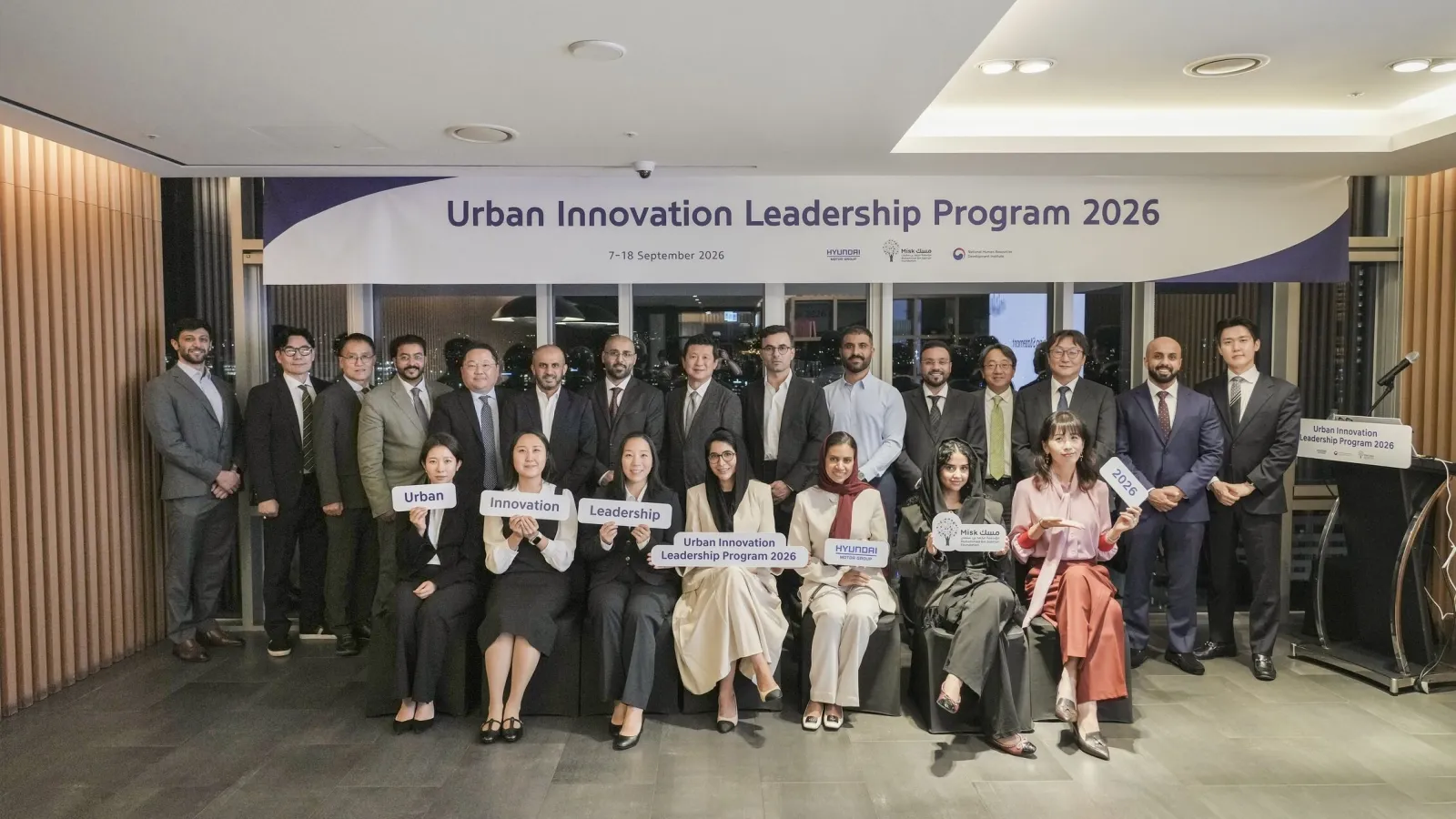
Hyundai Motor Group and the Misk Foundation have concluded a two-week Urban Innovation Leadership Program in Seoul, bringing together members of the Saudi Leadership Society and alumni of Misk leadership initiatives. The programme ran from 7 to 18 September 2026 and covered smart cities, autonomous mobility, the hydrogen economy, digital-twin technology and robotics.
The initiative builds on a memorandum of understanding the two organisations signed in 2024. Participants were jointly nominated by Hyundai and Misk and followed a structured curriculum combining lectures, site visits to hydrogen ecosystem facilities and autonomous-vehicle test beds, and collaborative workshops.
Hokeun Chung, Executive Vice President and Head of Future Strategy at Hyundai Motor Group, said the programme "laid a meaningful foundation for Saudi Arabia's policy development," describing the Kingdom as "a partner with whom we share a common future vision."
Strategic context
Hyundai frames the initiative as a deliberate shift in its approach to Saudi Arabia: from technology sales toward policy-level partnership, with the stated ambition of establishing a platform for systematic Korea-Saudi regulatory dialogue. That positioning is commercially significant. Saudi Vision 2030 allocates substantial sovereign capital to diversifying away from oil, with smart-city development, hydrogen infrastructure and electric mobility among its headline technology bets.
For an automotive and mobility conglomerate with brands spanning Hyundai, Kia and Genesis, embedding at the policy-dialogue level offers an early-mover advantage in procurement frameworks and infrastructure standards before individual contracts are awarded. Several large South Korean industrial groups have pursued similar government-to-government engagement strategies in Gulf markets over the past decade.
Market and policy read-across
The hydrogen strand of the programme is the element most relevant to the energy-transition investment community. Saudi Arabia is pursuing both green hydrogen, produced by electrolysis powered by renewable energy, and blue hydrogen, produced from natural gas with carbon capture. The country's NEOM gigaproject includes a flagship green-hydrogen and green-ammonia export facility developed in partnership with Air Products. Hyundai, for its part, has commercialised hydrogen fuel-cell vehicles and has broader ambitions in the hydrogen value chain, including heavy-mobility and industrial applications.
The programme does not represent a capital commitment, a signed offtake, or a technology deployment milestone. It is a leadership-development and relationship-building exercise, and the release contains no disclosed funding, no contracted volumes and no project financial terms. Its market relevance lies in signalling the seriousness with which Hyundai is investing institutional resources in positioning itself within Saudi Arabia's Vision 2030 procurement ecosystem.
Investors tracking Korean industrial exposure to Gulf energy-transition spending, or monitoring how hydrogen-economy standards are being shaped in early-stage regulatory dialogues, will note the programme as a relationship signal rather than a deal event. The next meaningful milestone would be a concrete collaborative project, a named technology deployment, or a policy-dialogue outcome with regulatory significance.